
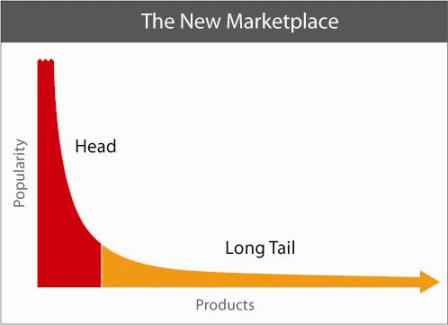
My latest read is a book by Chris Anderson, Editor of WIRED magazine. I read one of those Soundview Executive Book Summaries about it, then read the original article that started it all on WIRED.com, and finally found the book at The Salvation Army this past Friday!
I'd like to elaborate on just a few points from that synopsis. Chris Anderson hypothesizes that the age of the "hit" is over. People no longer watch the same TV shows. Even if they do watch the same show, some people TiVO it and watch it at a later date. Many follow TV series online or by purchasing the DVD's after the season has ended.The Long Tail or long tail is a retailing concept describing the niche strategy of selling a large number of unique items in relatively small quantities – usually in addition to selling fewer popular items in large quantities. The concept was popularised by Chris Anderson in an October 2004 Wired magazine article, in which he mentioned Amazon.com and Netflix as examples of businesses applying this strategy.[1][2] Anderson elaborated the Long Tail concept in his book The Long Tail: Why the Future of Business Is Selling Less of More (ISBN 1-4013-0237-8).
The distribution and inventory costs of businesses successfully applying this strategy allow them to realize significant profit out of selling small volumes of hard-to-find items to many customers instead of only selling large volumes of a reduced number of popular items. The total sales of this large number of "non-hit items" is called the Long Tail.
From Wikipedia - The Long Tail
This is evident also in the realm of record sales, movies, etc. There are more alternatives, and people are turning to them. We will never see another band like The Beatles. There will never be another show like I Love Lucy.
And here's where my thoughts digress from the long tail. What are the effects of all these niche markets? We're all splintered into individualistic groups. We have less and less in common with each other. Hundreds of years ago, the vast majority of the population (let's say 80%) grew up on a farm or in a rural area. Their fathers all did the same things. Their mothers all did the same things. It made finding a spouse a whole lot easier, because everyone had roughly the same expectations.
This is no longer the case in society today. We all come from different backgrounds and have different expectations. And although we may be intimately familiar with our own scenario, we are often woefully unaware of the scenarios of those with whom we interact.
Another digression - happiness. More choice does not lead to more happiness. In fact, contrary to what most people assume, more choice generally leads to lower satisfaction with the choice which has been made.
So where does this lead us? Everyone now comes from a different background. Everyone listens to different music and watches different television shows and movies and can find whatever they need to be an individual. And then they wonder why they're alone.
Maybe the BORG had it right. You will be assimilated.
Dave Matthews also put it well in his song Typical Situation
It's a typical situation in these typical times
Too many choices, hey yeah
It's a typical situation in these typical times
Too many choices
Everybody's happy everybody's free
Keep the big door open, everyone'll come around
Why're you different, why are you that way
If you don't get in line we'll lock you away


1 comment:
Jenny and I come from EXTREMELY different backgrounds... which I actually kind of like :)
So are you arguing for or against the way society is now... everything so individualized?
Post a Comment